
College A&P Teach physiology with real human data
Give your A&P lab a physiological signal students can record, measure and explain.
Add EMG and ECG investigations to your existing A&P labs. Start with a complete muscle activity lesson, then assess controlled comparisons, physiological reasoning and measurement limits.

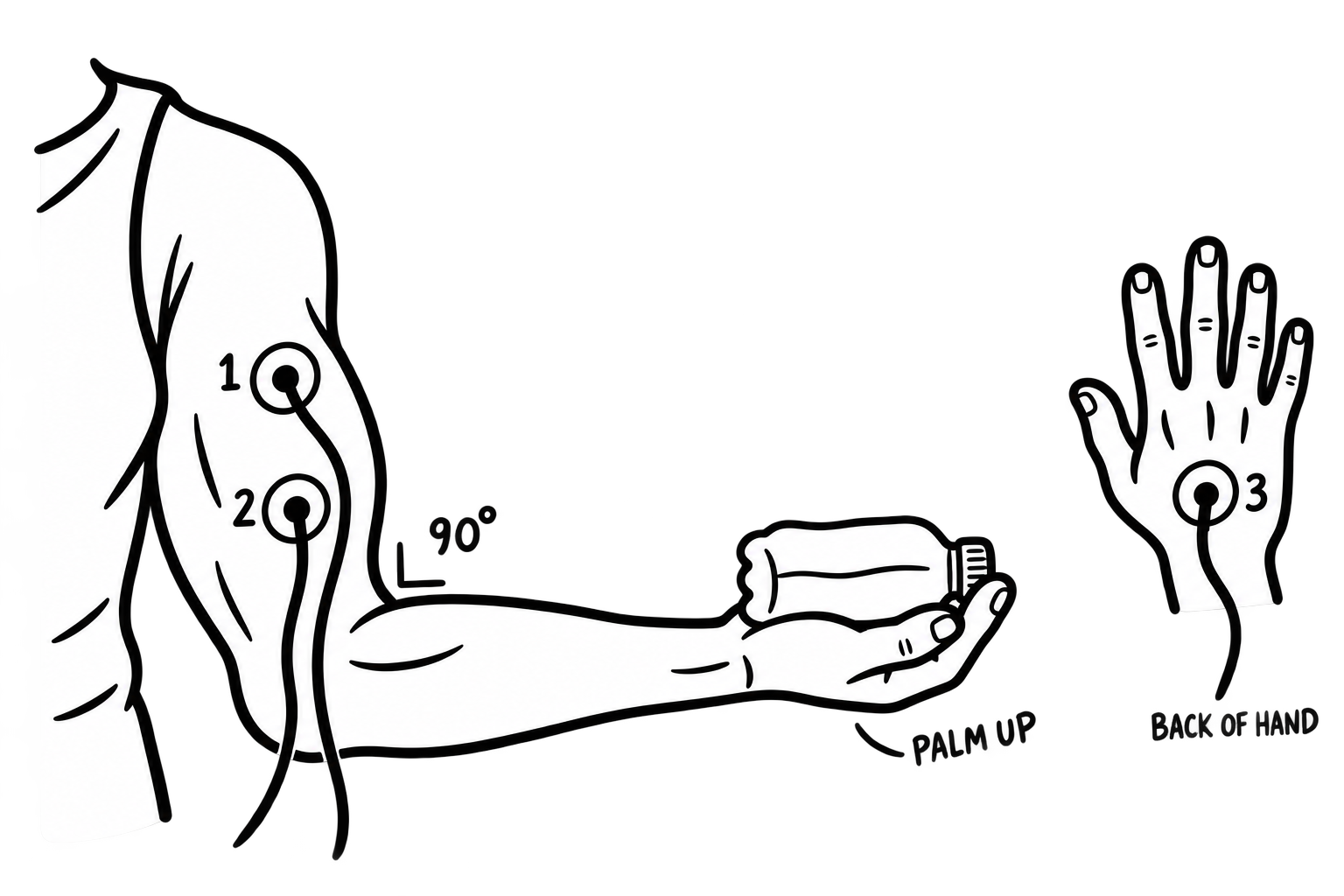
First lesson Does load change muscle activity?
Students hold two light loads at the same elbow angle, record biceps EMG and measure RMS over equal time windows. Six trials make the question testable: does the signal change when the load changes?
The lesson includes a printable student worksheet, teacher key, data table, graphing prompts and current software steps. Add paired differences and discussion of uncertainty for college students.
What students learn
A controlled comparison
Hold posture and electrode placement constant. Measure equal windows, retain repeat trials and document artifacts.
A visible learning outcome
Assess a labeled graph, physiological explanation and measurement limit. A result does not need the expected direction to earn full credit.
A way for everyone to contribute
Share deidentified volunteer recordings. The included synthetic practice data supports analysis-only teaching when no recording is available.
Fit the investigation to your course
Plan 75–90 minutes for the recording activity plus paired comparisons, methodological critique and an individual explanation. A shorter 60-minute core is supplied. These are planning estimates; rehearse the workflow on your lab computers.
Use the lab in skeletal-muscle physiology, motor control or an introductory allied-health/prenursing sequence. The college extension distinguishes repeated trials from independent participants and discusses why EMG cannot substitute for a force measurement.
What your first station needs
Start with one Human SpikerBox, three fresh electrodes per volunteer, a USB data cable and a computer running Spike Recorder. The featured lesson adds two plastic bottles and 250 mL of water. No Reaction Timer or Reflex Hammer is required.
The worksheet follows the current browser app on Chrome/Edge or Chrome on Chromebook. Managed devices must allow serial access. For iPad, iPhone or Android, check the native app and data cable for that specific device before you plan the class.
One recording kit. Muscle, heart & brain
-
Human SpikerBox
The human physiology recording kit
Use the same kit for EMG, ECG, EEG and eye-movement recordings, with the appropriate setup. The lesson here uses one channel and one electrode cable. Includes battery, USB-C cable and 12 patches; bring your computer. No timer or reflex accessory is needed.
$299.99
-
Large Muscle Electrodes
Plan fresh patches for each placement
Keep your class ready for the next volunteer. Three fresh patches per biceps placement; six trials use the same attached set. Removed patches are not reused. Plan for every section and a few replacements.
$24.99


Explore more human physiology
After the first EMG lab, use another human recording to explore a new physiological question. Each activity has its own setup and teaching scope.
How do muscles share the work?
Record biceps and triceps together. Compare agonist/antagonist roles and coactivation. Uses both channels and five patches with a shared reference.
Explore paired-muscle EMGWhat makes a heartbeat visible?
Record a surface ECG from the wrists, identify repeating features and estimate heart rate. Connect the trace to cardiac electrical events.
Explore the ECG activityCan you see a brain rhythm?
Explore EEG and alpha activity with the included headband and gel. Add this after students can discuss contacts, noise and muscle artifacts.
Explore the EEG activity

Use the evidence for your course review
The featured lesson supports isometric-contraction reasoning, quantitative comparison and experimental design. Its college extension adds repeated-measure analysis and limits of surface EMG. These are selected contributions to your A&P course, not a full replacement lab curriculum.
On a phone, scroll the table sideways to see every column.
| Focus | Student evidence | What needs additional teaching |
|---|---|---|
| Muscle activity during an isometric hold | Prediction, rest/hold comparison and pathway drawing. | Other contraction types; muscle structure and histology. |
| Load and EMG amplitude | Six trials, RMS table, graph and within-person differences. | Independent force measurement; recruitment versus rate coding. |
| Quality of an experimental claim | Artifact decisions, a supported conclusion and one improvement. | Generalization across people and formal statistical inference. |
For HAPS review, relevant muscle topics include AP-19-G-06-06 (contraction types) and AP-19-G-06-04 (recruitment using tension/stimulus evidence). This static EMG activity provides partial coverage only: surface voltage is not tension. The official combined A&P outcomes are for a two-semester undergraduate sequence; HAPS does not endorse or certify these materials.
Judge and colleagues (2020) describe cardiac and skeletal-muscle activities at two community colleges. That study is useful implementation literature; it did not evaluate this new bottle protocol or establish its timing or learning results.

Make room for a real experiment.
Start with the lesson. Rehearse one station. Then choose the station count and supplies that fit your students and schedule.
Equip your class one station at a time
Plan your station count
Tell us your class size, number of sections, devices and first lab. We can discuss an equipment list for one shared station or a class set.
School purchase orders
BYB accepts purchase orders. Include your equipment list, shipping destination and required date when asking about current terms and delivery.
Paperwork, ready to use
Download the signed W-9 for your purchasing office. The sole-source letter (PDF) is available too.


Keep exploring
Teach the featured lab
Download the worksheet and teacher key, or follow the full lesson online.
Open the EMG investigationHigh-school & dual enrollment
Match the schedule, assessment and purchasing plan to your teaching setting.
High-school implementationClassroom funding
Find educator funding programs and build an equipment request around a specific lesson.
Find classroom funding
One station can provide a shared class recording. For 24 students working in groups of four, use six stations. With one volunteer at each station, the featured lesson uses 18 patches; if all 24 students choose to record, it uses 72. Each new placement uses three fresh patches, while all six trials use the same attached set. Allow extras for re-placements and count each class section. Each kit includes 12 patches; replacement packs contain 50.
The featured lesson uses current Spike Recorder on a laptop or Chromebook with USB recording. Use Chrome or Edge on a supported computer, or Chrome on Chromebook. Managed devices may need permission for serial access. BYB also offers native apps; mobile OS, ports and cables require separate checking. Test connect, record, save, reopen and Measure on one actual classroom device before preparing the class set.
Human SpikerBox records electrical signals in EMG, ECG, EEG and eye-movement configurations. It has two recording channels. This lesson measures surface EMG amplitude with RMS; it does not directly measure muscle force, individual motor-unit firing or health. Keep any force, pressure or other acquisition equipment your course needs.
The online lesson and PDFs contain the materials list, placement schematic, current app steps, six-trial procedure, blank data table, analysis prompts, synthetic practice data and teacher key. This is a new lesson: the exact bottle protocol, timing and learning effects have not yet been classroom validated. A useful lesson does not require students to obtain a particular direction of change.
Students can record, time, graph and explain shared volunteer data without wearing electrodes. If no usable recording is available, the supplied synthetic dataset supports the same calculation and interpretation questions. Label it as an analysis-only activity; it does not assess acquisition skills. Never require personal recording for credit.
The supplied steps are written for Human SpikerBox and current Spike Recorder. Older Muscle SpikerBox models and other acquisition systems may support a similar investigation, but connectors, channels, file formats and measurement tools differ. Send the model, computer/OS and intended activity through Contact so we can discuss the setup before you buy.