
AP Psychology Put behavior to the test
Hands-on experiments. Real data for your classroom.
Bring neural signaling, sensation, reaction time and EEG into AP Psychology with experiments and teaching materials you can use now. These investigations also underpin our forthcoming NSTA Press curriculum.

Connect these experiments to your AP Psychology course
Start with the experiments linked below and the public Module 1.1 teaching materials. Our neuroscience laboratory curriculum, planned for publication with NSTA Press in 2027, brings this work together in 14 modules across Neurons, Systems and Brains. It is written for high-school teachers, including those without a neuroscience background, with explicit connections to AP Psychology.
The teacher materials include 50- and 75-minute pacing plans, preparation checklists, suggested teaching prompts, troubleshooting guidance, student handouts and assessment rubrics. Students progress from guided investigations to their own questions, data analysis and scientific mini-posters.
The plan offers teacher-demonstration options for touch, adaptation and neuropharmacology, plus behavioral alternatives in capstone projects. Choose the route that fits your class, and follow the module’s preparation and prerequisite guidance.
| AP Psychology focus | Curriculum modules and student work |
|---|---|
| Neural firing and chemical signaling · Unit 1 | 1.1 See and Hear Neurons and 1.4 Neuropharmacology: record spikes, model neurotransmission, and compare cricket responses after saline or MSG. The animal preparation and chemical investigation need their full teacher guidance. |
| Sensation and adaptation · Unit 1 | 1.2 Neurons for Touch and 1.3 Neuronal Adaptation: construct a sensory homunculus, compare responses to touch, and graph firing during sustained stimulation. |
| Nervous-system responses and attention · Units 1–2 | 2.3 Reaction Time and 2.4 Reflexes and Reactions: compare sensory cues and response rules, distinguish reflexes from voluntary responses, and explain measurement variability. |
| Brain research and attention · Units 1–2 | 3.1 See Your Own Brain and 3.2 P300 Response: compare EEG conditions, examine target and standard tones, and evaluate signals alongside noise and variation. |
| Sleep, memory and evaluating evidence · Units 1–2 | 3.3 How to Read Like a Scientist: identify a paper’s question, methods, results and conclusions, using the published sleep-memory study; evaluate evidence, bias and competing claims. |
| Health and performance · Units 1 and 5 | 2.1 Muscle Fatigue includes an optional discussion of mental versus physical fatigue, attention, stress and motor performance. The recording measures muscle activity; it is not a measure of a student’s mental health. |
| Research methods across the course | Capstones 1.5, 2.5 and 3.4: develop a question, define variables and controls, collect and graph data, and defend conclusions in a mini-poster. Notebook and rubric guidance supports the process. |
The course connections above use today’s AP framework. Concept Application, Research Methods and Design, Data Interpretation, and Argumentation depend on the work students actually do. These selected modules supplement your course; they do not cover all five AP units.
EEG taught in psychology classrooms
Smith and colleagues describe alpha-wave and P300 investigations in the Journal of Undergraduate Neuroscience Education. Their classroom work included recordings from 30 participants in four psychology classes at Minnesota State University, Mankato.
Use the paper to plan the method, examine artifacts and discuss why averaging matters. Recordings varied, and some apparently clear P300 responses could not be distinguished from noise. This is published undergraduate classroom work; it does not establish AP exam gains.
Choose what your students will measure
Each route leads to an existing experiment with its own setup and procedure. Choose the comparison and student work, then check the materials and your school’s recording setup.
Start with an investigation
Reaction time and response rules
Measure the delay from a visual stimulus to muscle activity across repeated trials. Use the go/no-go follow-up to compare response rules and errors. A task difference does not isolate the duration of a thought. Requires a Human SpikerBox and Reaction Timer.
Read the reaction-time labEEG with eyes open and closed
Record scalp potentials and look for changes in the alpha band between eye conditions. Evaluate noise and individual variation. Requires a Human SpikerBox, EEG headband, electrodes and supplies listed in the method.
Read the EEG experimentNeural firing and sensation
Hear and see spikes from a cockroach leg, then explore responses to touch. Make neural firing measurable while distinguishing a recorded signal from a person’s perception. Requires a Neuron SpikerBox and the animal preparation.
Read the neuron experiment

Follow the next question
For reaction time, compare the simple response with the existing go/no-go task; use the motor-choice task when students select between two movements. For EEG, the auditory oddball/P300 experiment adds repeated trials and averaged responses. Follow its current software and analysis instructions.
The existing neural-adaptation experiment extends the neuron route. A reduced response to sustained stimulation supports discussion of adaptation; it is not by itself evidence of learned behavior.
Available now See & hear a neuron
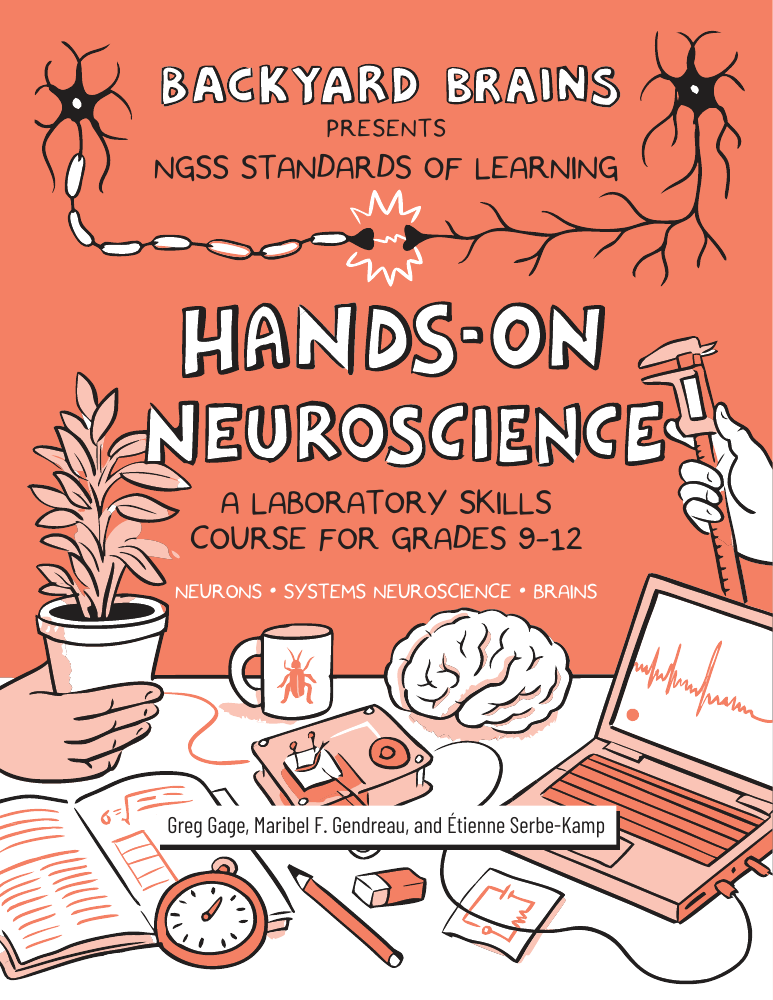
Preview the teaching approach with the public Module 1.1 sample, See & Hear a Neuron, from Hands-On Neuroscience: A Laboratory Skills Course for Grades 9–12. It includes teacher plans, recording, graphing and discussion using a cockroach leg preparation. If your class cannot use insects, explore the human reaction-time and EEG routes above.
What's inside
- The module summary, learning objectives and both lesson plans: six 50-minute lessons, or four 75-minute lessons
- Teacher notes for each lesson, with slide-by-slide prompts, the clay neuron model and the action-potential flipbook
- Setup for recording from a cockroach leg with the Neuron SpikerBox, and the materials list
- Data analysis, graphing guidance and the reflection questions for group discussion
How to Read Like a Scientist: sleep and memory
Module 3.3 already uses Mar’i and colleagues’ sleep-memory paper to teach scientific reading. Students identify the question and hypotheses, reconstruct the method, interpret figures, and assess conclusions. Its paper organizer and evidence checklist are part of the forthcoming teacher materials; the published study is linked below for reading now.
Can replaying a learned sound during sleep affect later recall? The study compares changes in location-memory error for cued and uncued items. Examine its controls, exclusions and alternative explanations before considering a recording project.
The study had seven adult sleep completers and two awake controls. Its recording protocol requires one continuous 3–4-hour session, including an approximately 90-minute nap. The existing experiment is an advanced project with participant and institutional requirements; reading and analyzing the paper is the more practical starting point for a class.
More to explore in our published MIT Press book
Our earlier book, Gage and Marzullo’s How Your Brain Works: Neuroscience Experiments for Everyone (MIT Press, 2022), contains 46 numbered experiments. Find reaction time in Chapter 23, EEG in Chapter 10, P300 in Chapter 13, neurons and touch in Chapters 2–3, and sleep and memory in Chapters 11–12.
For a starting point without electronics, MIT Press publishes its ruler-drop reaction-time excerpt. This measures the catch response through a falling ruler, a different endpoint from the EMG timing route above.
Choose the method. Then the equipment
-
Human SpikerBox
For reaction time, EEG and reflex recordings
Check the selected experiment’s complete materials list. Reaction time needs a Reaction Timer; EEG needs its headband, electrodes and supplies. Confirm accessory availability and test your school device before scheduling.
$299.99
-
Neuron SpikerBox
For neural firing, touch and adaptation
Use the existing cockroach-leg method and Module 1.1 materials. Plan the organism, preparation and consumables with your school before choosing this route.
$249.99




Plan your psychology lab.
Tell us which investigation you want to teach, your class size, devices and available recording stations. We can help identify equipment and supplies for that method.
Yes. Read and analyze the published studies, or use the ruler-drop activity published by MIT Press. Live electrical recordings require the equipment on the selected experiment page. The ruler and EMG methods measure different response endpoints.
You can use the existing experiments, published papers and Module 1.1 teacher PDF, slides and student handout today. The complete NSTA Press curriculum is planned for 2027 and builds on these resources. The public sample is an existing edition; final publication details may change.
We plan to bring the curriculum into our forthcoming app. Access options and pricing are still being developed. The public sample, existing web experiments and linked papers are available to explore now.
No. Scalp EEG records electrical potentials associated with population activity, mixed with possible artifacts. Alpha and averaged P300 comparisons can support an investigation; a trace is not a thought, emotion or individual attention score.
Follow the source for your selected route and rehearse it first. Module 1.1 includes six 50-minute or four 75-minute lesson plans. The sleep-memory recording project requires a 3–4-hour session before analysis. For electronics, test connection, recording, saving and analysis on your actual classroom devices.
These are supplemental resources for selected content and research practices, mainly Biological Bases of Behavior and Cognition. They do not replace the full five-unit course or establish College Board endorsement, exam-score gains or validated AP classroom outcomes.