
AP Biology Start with a real question
Existing investigations. Published teaching. Evidence students can examine.
Explore plant responses, neural signals and reaction time through established Backyard Brains experiments and teaching resources. Choose the question and student task, read the method, then select the equipment your class needs.


A teacher’s plant investigation
Biology teacher Jessica Shin and colleagues describe a five-week investigation with ninth-grade honors biology students in The American Biology Teacher. Students investigated the controversial question “Can plants learn?” using peas and Mimosa, designed studies, examined controls and presented findings for peer critique.
Read it for the teaching sequence and its treatment of uncertain results. This behavioral investigation does not require a Plant SpikerBox. It does not establish that plants learn or measure AP learning gains. Publisher access may be required.
Choose the question your students will investigate
Start with an existing method. Each route has its own materials, preparation and scope; the teacher selects the comparison, student work and course connection.
Read an existing experiment
Venus flytrap signals
Record a plant’s electrical response while touching its trigger hairs. Compare the recording with trap movement and consider what the trace can show. Requires a healthy flytrap, Plant SpikerBox and supported recording device.
Read the flytrap experimentMimosa responses
Record electrical signals alongside touch-evoked leaf movement. Distinguish the observation from the biological mechanism. Requires a healthy Mimosa, Plant SpikerBox and supported recording device.
Read the Mimosa experimentHear and see a neuron
Record spikes from a cockroach leg and compare responses to touch. Read the animal preparation and materials first. The public Module 1.1 below adds teacher plans, slides and student support.
Read the neuron experimentReaction time and variation
Measure repeated visual reaction times and compare observations. This human investigation uses a Human SpikerBox and Reaction Timer; its auditory follow-up adds another condition.
Read the reaction-time lab


Make the AP Biology connection
Plant responses offer a context for Topic 8.1, Responses to the Environment. Designing comparisons, representing recorded data and evaluating claims can develop Questions and Methods, Representing and Describing Data, and Argumentation. The practice depends on the work students actually do.
Neural and human recordings offer supplemental contexts for biological communication and response. An extracellular trace alone does not reveal a receptor pathway, second messenger or intracellular membrane voltage.
College Board requires at least 25% of instructional time for hands-on inquiry and at least two labs per big idea. Select these resources within your full course plan; they do not establish course approval or AP score gains.
Public sample See & hear a neuron
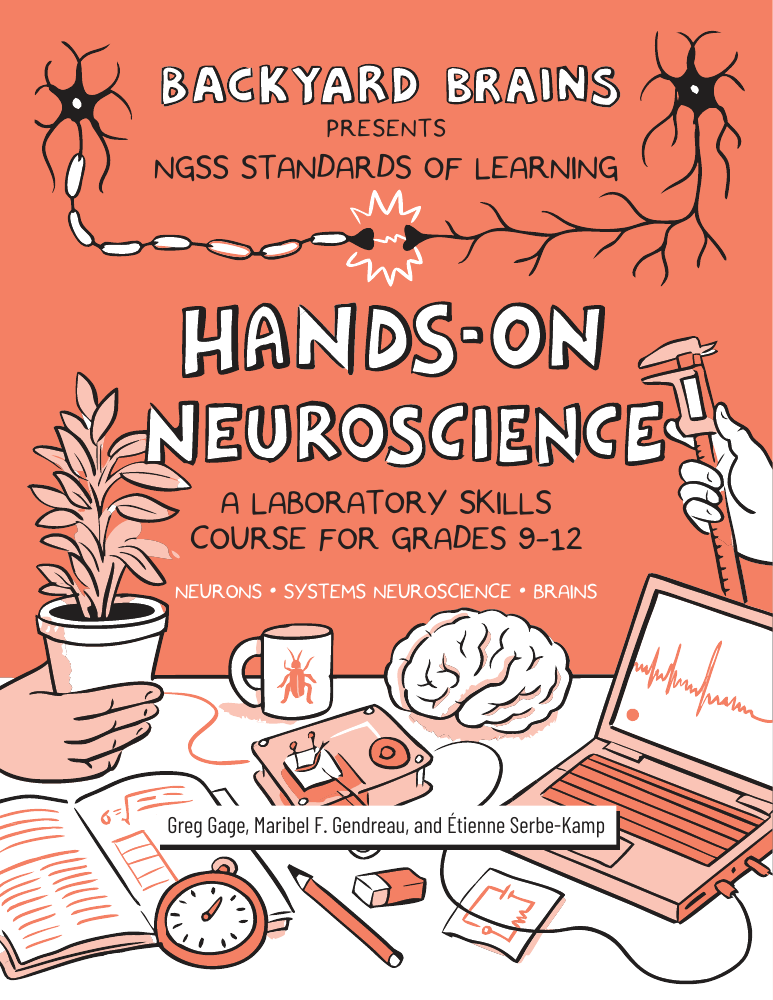
See the lesson before choosing a kit. Module 1.1, See & Hear a Neuron, is a complete sample from Hands-On Neuroscience: A Laboratory Skills Course for Grades 9–12. It uses a cockroach leg preparation and includes multi-period teacher plans, analysis and discussion.
What's inside
- The module summary, learning objectives and both lesson plans: six 50-minute lessons, or four 75-minute lessons
- Teacher notes for each lesson, with slide-by-slide prompts, the clay neuron model and the action-potential flipbook
- Setup for recording from a cockroach leg with the Neuron SpikerBox, and the materials list
- Data analysis, graphing guidance and the reflection questions for group discussion
Follow the published evidence
High-school students coauthored the 2024 plant-response library. Its methods, recordings and analysis resources let students examine how research was conducted, including uncertain or unsuccessful recordings. The project involved sustained research support; it does not establish a short AP lesson’s success rate.
Gage and Marzullo’s How Your Brain Works: Neuroscience Experiments for Everyone (MIT Press, 2022) contains 46 numbered experiments across neurons, muscles, heart, brain signals and behavior. Explore its established methods and follow-up questions for the animal and human routes. This edition has no plant chapter.
Choose the method. Then the equipment
-
Plant SpikerBox
For the plant-recording routes
Record flytrap or Mimosa electrical responses with the specified electrodes and supported device. Plants and a recording computer are additional. Read care and preparation requirements first.
$149.99
-
Neuron SpikerBox
For the live-neuron route
Use the cockroach-leg preparation in the existing experiment and public teacher module. Plan the organism, supplies and animal-care requirements with your school.
$249.99
-
Human SpikerBox
For human physiology and reaction time
Select the existing human investigation and its materials. The reaction-time activity also requires a Reaction Timer. Check accessory availability and your exact school setup before scheduling.
$299.99




Plan the class you teach.
Tell us which investigation you want to run, your class size, devices and available recording stations. We can help identify the kits and consumables for that activity.
No. The 2021 teacher paper describes behavioral pea and Mimosa investigations without a Plant SpikerBox. Electrical recordings require the kit and materials on the selected experiment page.
Module 1.1’s teacher PDF, slides and student handout are public. The Teachers page lists all 14 course modules. Journal and open-access research are linked separately; publisher access rules apply.
These are supplemental investigation choices. Select the required content, practices and student work within your full AP course plan. No College Board approval or exam-score improvement is claimed.
Use the selected source’s scope. The 2021 classroom project ran for five weeks; Module 1.1 supplies six 50-minute or four 75-minute lesson plans. Rehearse your recording setup and allow time for analysis before setting a schedule.
Preserve the attempt and its conditions in student records. Check the original protocol and distinguish biological variability from contact artifacts. If students analyze a teacher recording or published data, name its source and distinguish that analysis from their own live acquisition.