
Record EMG
Place electrodes on the forearm and use Spiker:bit to detect the muscle signal produced when you flex.
Spiker:bit project
Use EMG muscle signals from your forearm to trigger a servo-powered web flinger with Spiker:bit and BBC micro:bit. It is a playful superhero build that teaches biological signals, threshold logic, MakeCode, and micro:bit control.
 EMG
Servo
micro:bit
EMG
Servo
micro:bit

Featured in Make: Magazine
Make: Magazine’s Digital Fabrication Guide 2026 featured Backyard Brains designer Alex Hatch and the neuro-powered Spiker-Man Web Flinger. The project also appeared in Make: Live’s Volume 96 show-and-tell lineup.


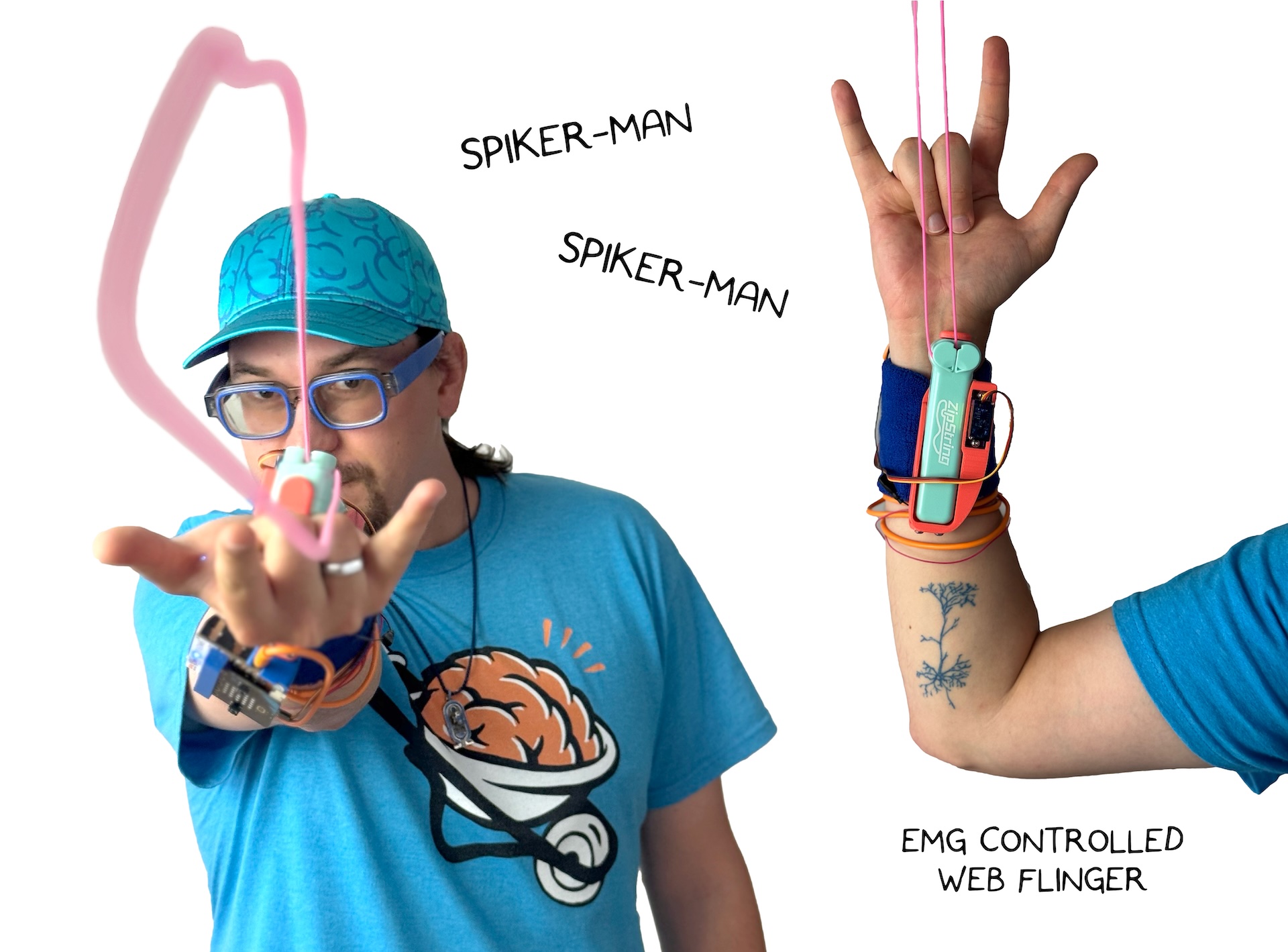
From muscle signal to motion
The Spiker:bit reads a real EMG signal from the arm. A simple threshold in code turns that biological signal into a servo movement, so students can see the path from nervous system activity to a physical microcontroller output.
Build flow
Place electrodes on the forearm and use Spiker:bit to detect the muscle signal produced when you flex.
Code a threshold so the micro:bit can tell the difference between rest and a strong muscle contraction.
Use the threshold crossing to move a small servo and launch the web-flinger mechanism.
Materials
Use Spiker:bit to turn forearm EMG muscle activity into a micro:bit input.
Use surface electrodes and the electrode cable to pick up the forearm muscle signal.
Add a small servo and classroom-safe wrist launcher materials for the web-flinger motion.
Core board
The board that turns biological signals into micro:bit inputs for EMG projects like Spiker-Man.
Code and docs
The current Spiker-Man path uses Spiker:bit and micro:bit MakeCode-style threshold logic: read the muscle power signal, set a threshold, and trigger a servo when the forearm EMG signal crosses that threshold.
FAQ
Yes. The project uses EMG muscle activity from the forearm to trigger a servo-powered web flinger.
The current version is positioned as a Spiker:bit and BBC micro:bit project. The retired Arduino Muscle SpikerShield archive remains available for older Arduino users.
The build centers on a Spiker:bit and BBC micro:bit, with electrodes, a small servo mechanism, a wrist-mounted launcher, and classroom-safe craft materials.
Yes. It is a classroom-friendly neuroengineering build when used as a supervised educational activity with surface electrodes and non-medical intent.